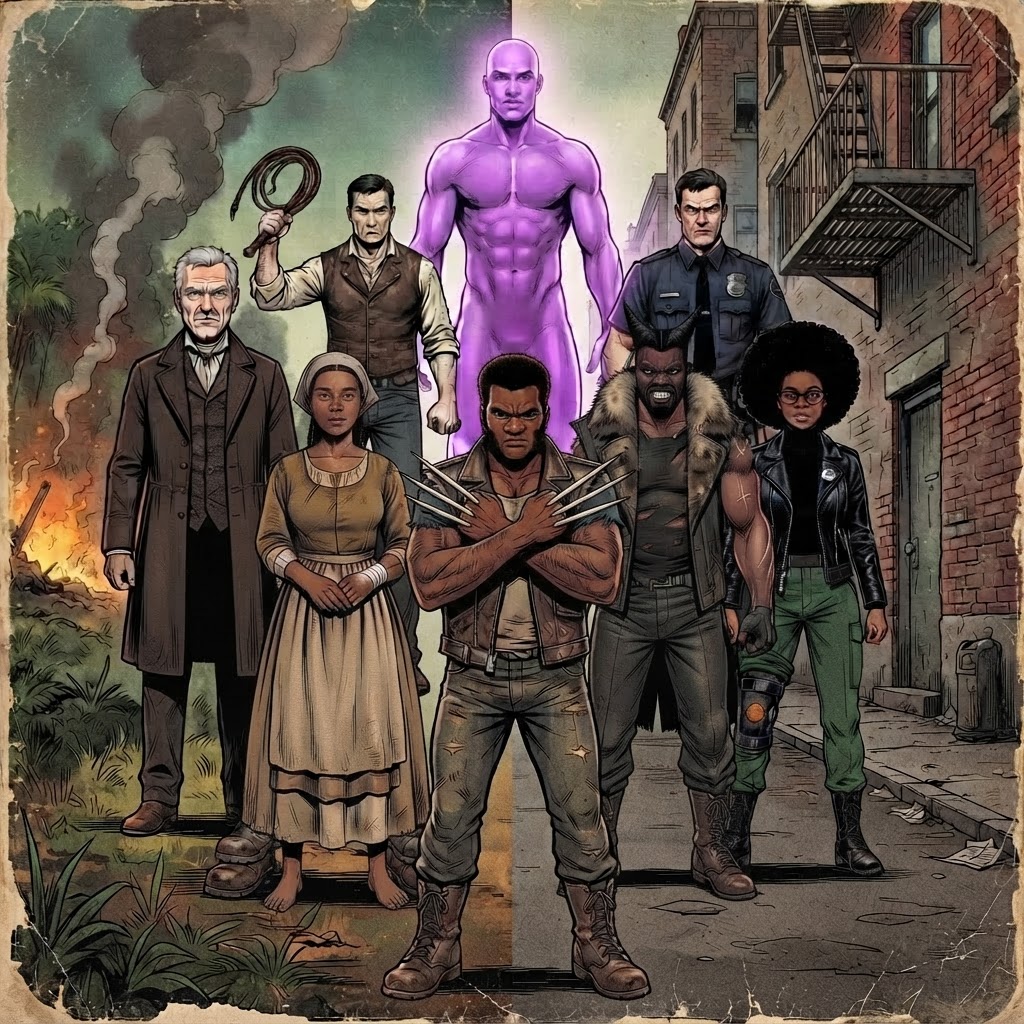
X-Mans Da Twelth: Dis One Cut Deep

by D D
Haunted by memories of past lives and brutal wars, Reen fights to protect those he loves, even as his own violent nature threatens to destroy him.
Comic Book
comedy
022
Translate this story
Manuscript
X-Mans 12: This One Cut Deep
(Warning: Sensitive Subject Matter)
The soldier beside Reen died before he finished saying his name.
One hand caught Reen's sleeve. The other pressed against a wound no amount of pressure was going to close. Reen dragged him down into the trench anyway, boots sliding through mud, while bullets clipped the dirt above their heads.
“Stay here,” Reen said, as if the man had somewhere else to go.
His fingers loosened.
Beyond him, a radio operator lay facedown beneath the weight of his own equipment. A third soldier crawled out of the smoke, reached for the trench, and stopped moving halfway there.
Reen looked down at himself. The heavy cloth he had felt a moment earlier had become thin green fatigues, wet through and clinging to his legs.
Something was wrong with that.
Something was wrong with everything.
Then a round struck his shoulder and knocked the thought clean out of him.
He hit the wall of the trench. Pain traveled down his arm.
Beneath the torn fabric, his flesh began closing around the damage.
“Still letting people shoot you?”
Reen knew the voice before he turned.
Sabertoof crouched beside him, younger in the face, his hair cut close beneath a helmet. Blood ran from his temple, but the split in his skin was already narrowing. He grabbed Reen by the collar and pulled him down as another burst tore across the trench.
For a moment Reen could only stare.
He remembered a forest.
A broken trunk.
His own hand completing a motion he could not take back.
“You supposed to be—”
“Paying attention? Yeah. Try it.”
An explosion swallowed the rest.
Vietnam. 1968. The place returned to him in pieces: the wet heat, the stink of burnt powder, the young man who had asked to borrow his razor that morning.
Reen looked toward that young man's boots sticking out beneath a torn poncho.
Sabertoof followed his gaze. His grin disappeared.
“Just us.”
Reen checked the men again. He did not want those two words to be true.
Across the clearing, muzzle flashes pulsed through a low fighting position.
Sabertoof raised his rifle and fired.
Reen crawled to the other end of the trench, found his own weapon beneath a dead man's arm, and pulled it free.
They moved when the firing paused. Neither had to explain the plan.
Sabertoof drew the next burst while Reen crossed the churned ground. A bullet spun Sabertoof sideways. He caught himself, swore, and kept shooting. Reen reached the edge of the position as an opposing soldier turned toward him. Reen fired first. Another came out of the smoke with his rifle raised, and Sabertoof dropped him before he could aim.
They fought through the position in a rush of noise and close, ugly movement. Reen's rifle clicked empty. A man lunged from behind stacked ammunition boxes.
Pale bone claws pushed through Reen's knuckles, and the man's momentum carried him onto them.
Reen pulled free, breathing hard.
Bone.
He stared at his hand. He knew the claws should have been metal. He also remembered when they had not been.
A shout made him turn.
Sabertoof was down on one knee, struggling with a soldier whose rifle lay between them. Reen crossed the distance and ended it. He caught Sabertoof under the arm before he could fall.
“Thought you was covering me,” Sabertoof muttered.
“Thought you was harder to kill.”
They stood together until the immediate gunfire stopped.
Farther away, the war continued without caring what had happened to their squad.
Sabertoof bent over a dead soldier, closed the man's eyes, and stayed there longer than Reen expected. When he rose, he pressed something into Reen's palm.
A strip of cloth. Red once, almost brown now.
Reen's stomach tightened.
That did not belong here.
Sabertoof looked at him. “Told you I'd get the key.”
The jungle went silent.
A bell rang somewhere behind the smoke.
* * *
The cloth was tied around the handle of a water bucket.
Reen stood beside a well with both hands gripping its rim.
Morning mist lay across a field beyond the cabins. His uniform was gone. A coarse shirt scratched his shoulders, and his feet were bare against cold earth.
Alabama. 1824.
He had not thought of that well in years. He remembered its stones more clearly than the faces of some men he had buried.
“You gon' stare in there till supper?”
Sabertoof leaned against the other side, narrow through the waist but already broad in the shoulders. He had no fur collar, no long coat, none of the things Reen associated with the man he had become. Just a patched shirt and a small piece of stolen bread tucked in his fist.
He broke it and passed half over.
Reen took it automatically.
They had known each other for years by then. Worked the same ground. Shared food neither could afford to lose. Watched people disappear after a white man consulted a ledger. But the secret between them had begun only a few months before the escape.
Reen remembered a woman named Ruth dropping a sack beside the storehouse. Her wrist had been swollen all morning.
When she tried to lift it again, her hand gave way.
The overseer struck her across the back with the handle of his whip.
Reen stepped between them before the second blow landed.
“She hurt. I'll carry it.”
Ruth caught his sleeve. “Reen.”
The overseer ordered him aside. Reen stayed where he was.
The handle caught him across the mouth, splitting his lip against his teeth. Then the overseer slashed the whip against Reen's bare back. The pain was intense, but the wounds started healing almost immediately.
He tasted blood, heard Ruth telling the man to stop, and felt a pressure inside both hands unlike anything he had ever known.
He thought the bones were breaking.
Three pale points tore through each set of knuckles.
Reen shouted and jerked backward. The overseer stumbled away from his hands, caught his heel on the fallen sack, and struck the ground. For an instant all three stared at the curved lengths of bone extending from Reen's fists.
Then Ruth moved. She shoved the sack across the man's legs and pulled Reen toward the narrow space behind the storehouse.
“Go,” she said. “Before he gets up.”
Sabertoof met them at the far corner. He took one look at Reen's hands and sent Ruth toward the washhouse, where other women could see her arrive.
Then he drew Reen behind an unused shed.
Reen could barely breathe. Blood dripped from his fingers.
“Get them out.”
“Keep your voice down.”
“Look at my damn hands.”
“I'm looking.”
Sabertoof stayed with him until the bone slowly withdrew.
Reen watched the torn skin close behind it. He touched his mouth. The split in his lip was gone too.
He looked up, waiting for Sabertoof to back away.
Instead, Sabertoof held out his own hand.
The nails lengthened into hard, curved points.
Reen forgot what he had been about to say.
“How long?”
“A while.”
Sabertoof lowered his voice.
“Hear things I shouldn't. Smell somebody coming before I see them. Got cut last week. By the time I found something to wrap it, wasn't nothing there.”
“And you ain't tell me?”
“Didn't know what to tell.”
Reen looked between their hands. Whatever had been hidden inside them, neither the overseer nor his whip had put it there.
Sabertoof's changes had already begun. The terror and anger had brought Reen's to the surface.
That evening, Ruth found them behind the cabins.
The overseer had accused her of helping Reen attack him, but she had arrived among the women without a weapon, and he could not explain the claws without sounding drunk. She knew he would keep looking for a chance to punish them.
“He asks again, I didn't see your hands,” she said.
Reen thanked her. She touched his healed mouth, then pulled her hand back in wonder.
After that, they learned in secret. Reen practiced bringing the claws out without shouting. Sabertoof learned to separate one approaching person's footsteps from another's. Once, Reen found him pulling a nail from his palm, the puncture closing before the nail hit the dirt.
They laughed quietly then, relieved to have each other. They knew they healed. Neither yet understood how slowly the years would mark them.
At the well, Reen flexed his fingers around the stolen bread.
The memory of Ruth's hand on his sleeve faded, leaving Sabertoof watching him across the bucket.
A little girl came toward the well carrying a cup in both hands.
Reen lowered the bucket so she could reach it.
She drank, wiped her mouth with her wrist, and asked if he could fix the loose wheel on the wooden toy her brother had made.
“Bring it tonight,” he told her.
Sabertoof watched her leave.
“Her mama on the list.”
Reen stopped chewing.
“What list?”
“The one in that office. Wagon coming Friday.”
Reen looked toward the big house.
He remembered this morning now.
Remembered every ordinary task that had followed while he carried that knowledge through the day. Remembered the girl's toy sitting on a step after dark, waiting for a repair.
They had discussed leaving before.
Whispered routes and warnings. Put aside food, lost it, started again. This time they went cabin to cabin after the lamps in the big house were extinguished.
Not everyone could make the same journey. Not everyone wanted the same risk.
Reen listened while an older woman named Essie argued that the youngest children would never keep up. Sabertoof knelt beside her and showed her the wagon key.
“We ain't asking them to.”
He had stolen it that afternoon. A red strip of cloth kept it from rattling against the other key in his pocket.
The bell rang again.
Reen turned. Night should have been silent.
For an instant, purple light shone in the upstairs window of the big house.
Then the front door opened, and Nathaniel Rusk stepped onto the porch with a pistol. His grown son followed, carrying a shotgun. Both white men looked first at the waiting wagon, then at the people gathering beside it.
Rusk called them thieves.
Reen remembered thinking that even then, even with their own lives at stake, the man could not imagine anything being taken except his property.
Sabertoof moved toward the porch. Rusk's son fired.
The blast drove Sabertoof backward. He hit the ground hard enough to make Essie cry out. Reen felt the pistol shot enter his own chest a moment later.
He staggered. Stayed upright.
Rusk lowered the weapon an inch.
Reen walked toward him.
The man began shouting for help. He had never sounded like that before. Reen heard him, saw the open door behind him, and knew that leaving him alive would mean dogs, riders, and the children dragged back by morning.
Bone broke through Reen's skin.
Rusk tried to raise the pistol again. Reen caught his wrist and drove his other hand forward.
Behind him, Sabertoof rose.
The younger Rusk backed toward the doorway, fumbling with his gun. Sabertoof reached him before he could fire again. Their struggle knocked a chair over. Then the porch was quiet.
Reen stood over the man who had called himself his owner.
He did not feel like property. He did not feel like a hero either.
He felt the hole closing in his chest and heard a child crying behind him.
“Get everybody up,” he told Sabertoof.
They took the wagon.
Essie counted children twice, then ordered two frightened adults back down to help someone climb aboard.
Reen retrieved the wooden toy from the step and shoved it into the little girl's hands.
For a moment she looked more surprised by that than by anything else.
They left before dawn.
The escape was not one clean journey into safety. There were hiding places, wrong turns, people willing to help and people who would have sold them back.
They divided into smaller groups because a wagon full of fugitives could not remain invisible. Reen walked until his feet bled and healed, then bled again.
At a fork beside a swollen creek, he and Sabertoof finally separated, each taking people toward a different contact.
Sabertoof clasped his forearm.
“If I find somewhere good, I'll send for you.”
“Better have food.”
“Ungrateful bastard.”
Reen watched him disappear among the trees.
He remembered waiting for word.
The memory skipped before the waiting ended.
* * *
A metal tray struck the table in front of him.
“You still eat like somebody finna take it.”
Reen looked up into Sabertoof's face across a military mess table. More than a century had passed since the creek. Around them, young men complained about food and orders and the heat, unaware that the two men staring at each other were older than their grandparents.
Reen stood so abruptly his chair scraped backward.
Sabertoof grinned, then let out a startled grunt when Reen pulled him into an embrace.
For once neither had anything smart to say.
Later, they sat outside and compared the pieces of their lives they could bear to explain. Different names. Work taken and abandoned. Years spent keeping ahead of questions about why their faces never changed. Reen had entered this war carrying paperwork younger than some of his shirts.
“You couldn't find a quiet job?” Sabertoof asked.
“You here too.”
“Yeah, but I know I'm stupid.”
Reen laughed.
The sound hurt him now because he remembered how relieved he had been.
The mess table disappeared. Again he was standing beside Sabertoof in the clearing, their squad dead behind them.
“You left me,” Sabertoof said.
“At the creek? We agreed—”
“In the fire.”
Reen's jaw tightened.
“That ain't happened yet.”
Sabertoof smiled with somebody else's patience.
The smell of smoke became burnt toast.
* * *
In November of 1969, Reen stood in a church basement turning eggs in a pan while a little boy criticized his cooking.
“My mama don't make them brown.”
“Your mama accepting applications? Go eat at her house.”
The boy took his plate and went laughing toward the folding tables.
Across the room, Nadine Bell looked over her glasses at Reen.
She ran the neighborhood chapter of the Black Fang Party with an appointment book, a bad knee, and no patience for men who confused loudness with usefulness.
“You threatening the customers again?”
“Breakfast free. They ain't customers.”
“Then stop acting like they owe you a tip.”
He had been home from Vietnam for months when he found the Fangs. Before that came loading docks, overnight security work, and arguments with supervisors who discovered too late that he did not respond well to being grabbed.
There were mornings he woke still listening for men who had died overseas.
Drinking shortened some nights and ruined the next day.
The Fangs gave him somewhere to be before the liquor stores opened.
He carried groceries upstairs for people whose knees were worse than Nadine's. Fixed a door at the office. Walked children home. Sat through meetings until somebody used a phrase he disliked, then interrupted loudly enough to earn kitchen duty again.
He believed in the work.
That was what made the rest harder to remember.
A nineteen-year-old volunteer named Leon Price arrived early every morning with his shirt tucked in and a notebook full of plans for college. He could stretch a carton of milk across more bowls than Reen thought possible.
One afternoon, Officer Russell Braddock stopped him carrying donations back to the church.
By the time Reen reached the hospital, Leon had one eye swollen shut and a broken jaw. His mother sat beside the bed holding the bloodstained shirt someone had put in a paper bag.
Braddock's report called it resistance.
Leon tried to explain what happened.
The effort hurt too much.
Reen told him to stop talking.
Outside the room, his mother caught Reen's arm.
“Don't make me bury him over whatever you thinking.”
He did not promise her anything.
The next evening he stood in the Fangs' office beneath a calendar marked March 1970, arguing with Nadine while the others listened.
“We know where he drinks. We know when he gets off.”
“We also know who gets dragged out of bed after you do something,” she said.
“So we let him keep doing it?”
“We have witnesses.
We have people willing to put their names on statements.
We have a boy who needs money for treatment.”
“And he got a badge that say he can beat the next one tomorrow.”
Nadine put her palms on the table.
“You do not get to decide the risk for everybody in this room.”
Reen left before the meeting ended.
Two days later, Reen stood outside the police station holding a sign that read JUSTICE FOR LEON PRICE.
The Black Fangs filled the sidewalk with neighbors, church volunteers, and people who had never attended one of their meetings. Leon was still in the hospital. His mother stood beside Nadine, holding a photograph of him taken before the beating.
“Who protects our children?” Nadine called.
The crowd answered loudly enough to turn heads across the street. Reen joined in the first time. He lifted his sign when the others lifted theirs. For a while, he tried to believe the noise could reach somebody willing to listen.
Behind the station windows, two officers watched.
One smiled at something the other said.
Reen lowered his sign.
Nadine was speaking to a reporter now, demanding Braddock's suspension and an investigation. A woman moved through the crowd collecting donations for Leon's treatment.
His mother kept the photograph raised even when her arm began shaking.
Reen stepped beside Nadine when the reporter moved away.
“How long we doing this?”
“As long as we need to.”
“He broke that boy's jaw. We out here asking his friends to punish him.”
“We're making sure they can't pretend nobody knows.”
“They know. They standing in there laughing.”
Nadine looked toward the windows, then back at him. “Stay with us.”
Reen stared at the picture in Leon's mother's hands. The boy in it was smiling with his whole face.
“Ain't no sign stopping that man,” he said.
He handed his placard to another member and stepped out of the crowd. Nadine called his name. He kept walking. Behind him, the chant rose again, growing faint as he turned the corner.
By nightfall, he had found Braddock's car behind the bar where the officer drank after work. Reen waited beside it. The officer came out adjusting his belt, recognized him, and stopped a few feet away.
“Your little club send you?”
“No.”
That much, at least, had been true.
Reen said Leon's name.
Braddock looked irritated by the inconvenience of remembering him.
“That boy should've learned to listen.”
Reen had gone there knowing what he meant to do. Later, when he tried rearranging the encounter in his head, that fact always remained where he had left it.
He killed Russell Braddock beside the car.
It was not a fight that got out of hand. It was not an accident.
When the officer fell, Reen stayed long enough to know he was dead, then walked away.
The memory held him there now.
Braddock opened his eyes.
“Feel better?”
Reen looked down at him.
“You didn't say that.”
The body smiled.
“You didn't say shit.”
A purple reflection moved across the car window.
Reen struck it with his fist, and the glass became the window of the Fangs' office.
Nadine stood on the other side of the desk.
“They searched Leon's mother's place this morning,”
she said. “Pulled his brother off a bus. People who gave us food won't answer the phone.”
“They was doing that before.”
“And now you handed them another excuse.”
“He ain't touching nobody else.”
“Look at me, Reen.”
He did.
“You didn't come back to help us handle what followed. You came back expecting congratulations.”
That landed harder than he wanted it to.
She pushed his office key across the desk.
“You're out.”
He looked at the key, then at the others. Nobody would look away first. He hated them for that in the moment. Hated that they knew him well enough not to be fooled by the anger.
“You think throwing me out make him worth crying over?”
“No,” Nadine said. “I think you hearing whatever lets you leave this room without listening.”
He took his coat. Left the key.
In the doorway, he looked back at the sacks of flour stacked against the wall. He had carried them in that morning.
The room vanished before he could decide whether to say goodbye.
* * *
Sabertoof found him months later in a bar where the tables rocked and the bartender watered the liquor without embarrassment.
Reen saw him reflected in the mirror and kept drinking.
“Heard you got put out your little revolution.”
“Heard you still ugly.”
Sabertoof pulled up a chair. For a while they talked about nothing that mattered. The weather. A man at the other end of the bar wearing shoes too expensive for the room. The military's talent for making terrible coffee in different countries.
Then Sabertoof put money on the table.
“Got some work.”
Reen looked at the bills.
“What kind?”
“The paying kind.”
“I ain't asking twice.”
“A man owes somebody. We encourage his memory.”
Reen could have left the money there. He remembered that clearly, even when the rest became convenient to forget.
He put it in his pocket.
The first man they collected from cried before either touched him. The second fought. By the third job, Reen had learned not to ask whether the amount was fair.
They joined a wandering crew that moved between cities, fighting for money and stealing when the fights paid badly. Reen liked having cash folded thick in his pocket.
Liked eating without calculating what would remain for rent. Liked being good at something people paid for.
At first, they chose jobs together.
Years passed across motel carpets and stolen cars. Sabertoof talked them through locked doors. Reen watched exits. They drank after jobs, laughed about narrow escapes, and occasionally paid each other's way out of trouble.
Then Reen began noticing how long Sabertoof stayed after resistance ended.
A clerk already on the floor. A driver who had handed over his keys. A man who stopped fighting but kept getting hit.
“Enough,” Reen said in one room.
Sabertoof looked up as if interrupted during dinner.
“You getting particular now?”
“He gave you the money.”
“Then he should've done that first.”
Reen pulled him away. Later they argued in the car, then stopped at a liquor store and behaved as if the argument had settled something.
The memory jumped.
Bright white lights. Leather across Reen's wrists. A voice beyond a glass partition discussing his bones as if he were absent.
Metal burned through him.
Reen jerked against restraints that had not been there a moment before. His lungs seized around a scream. He knew this place too, knew there were years and people and lies attached to it, but the room flickered before any face became clear.
“Oh, you picking now,”
he said through his teeth.
“Just skipping to whatever hurt.”
A man behind the glass turned. A thin mustache. A black durag that did not belong in the memory.
Then the man was gone.
Reen pulled one wrist free, and the restraint became the strap of a bag full of stolen cash.
* * *
Six workers stood against a warehouse wall.
Reen counted them before he remembered why the number mattered.
One had gray in his beard. One wore an engagement ring on a chain around his neck. A woman near the end kept looking toward a side door while pretending not to.
Sabertoof was carrying a fuel can.
“No,” Reen said.
The word came out before the older conversation could begin.
Sabertoof glanced at him. “One knows my face.”
“Then put something over it next time.”
The gray-bearded worker lifted both hands. “I didn't say I was telling anybody.”
Sabertoof shoved him through the doorway into a storage room. The others followed because his claws were out and they had nowhere else to go. He locked the door.
Reen dropped the bag.
“What the fuck you doing?”
“What you too soft to do.”
The fire caught along the spilled fuel.
For a moment Reen was at the plantation again, watching a man decide other people's lives belonged to him.
Then the workers began pounding on the door, and the warehouse returned.
Reen drove his metal claws through the lock.
Sabertoof seized his shoulder. Reen struck him hard enough to send him stumbling, then tore the door open. Smoke rolled over the workers as they pushed out. Reen pointed them toward the loading exit and went back for the man coughing on his knees.
Behind him, Sabertoof shouted his name.
Reen got the sixth worker outside.
He remembered the rest. The roar of the burning building.
Sabertoof somewhere inside, calling for the man who had once crossed a battlefield to reach him. Reen standing in the open doorway and choosing not to go back.
He had believed Sabertoof would die there.
The memory tried to make him turn around.
Reen planted his feet.
“Show it right.”
The six workers stood outside without faces now.
Their bodies blurred into smoke. Sabertoof appeared in the doorway wearing his military uniform, the red cloth tied around his wrist.
“You got out because of me.”
“And you got out because of me,” Reen said. “More than once.”
“You left your brother.”
“You locked six people in a room.”
Sabertoof stepped closer.
His uniform changed to the patched shirt from Alabama.
“We was supposed to stay together.”
Reen looked at that younger face. The anger did not protect him from it.
“I know.”
The admission hurt. He let it.
Then he looked at the empty place where the workers had been.
“But they was there too. Put them back.”
For a second the fire lost its sound.
Reen took a step toward Sabertoof.
“You want me to remember? Quit leaving shit out.”
The warehouse went dark.
* * *
When light returned, a jukebox was playing in the corner of a roadside bar.
Reen sat at a table with a bottle and a newspaper folded beneath one elbow. The year was 1988. By then he had stopped taking jobs with crews, stopped pretending a cut of somebody else's money was worth another room full of frightened people.
Quitting had not made him pleasant. The tavern he had recently wrecked was evidence of that.
A wheelchair stopped beside his table.
Behind it stood a large blue man wearing a rasta beanie.
Dreadlocks rested against his shoulders. He carried the same newspaper, folded to a photograph Reen would have preferred never to see again.
Reen looked from him to the bald man in the chair.
“Whatever y'all selling, I already got one.”
“We're not selling anything,” the man in the chair said. “My name is Zachary. Most people call me Z.”
“That's most people's problem.”
The blue man pulled out a chair and sat.
It complained beneath him.
“Mi name Monsta.”
Reen looked at him.
“Yeah. I was getting there.”
Monsta placed the newspaper on the table. Weeks earlier, he and Z had found that photograph while following reports of a healing mutant. It had taken longer to catch up with the man than with the damage he left behind.
“We thought you might need somewhere to go,” Z said.
“I got somewhere.”
“The room upstairs?”
“Got a bed. Door. Whole arrangement.”
“And when the proprietor sees this?”
Z tapped the photograph.
“He'll recognize the furniture.”
Monsta laughed before he could stop himself. Z gave him a look, then turned back to Reen.
“We're building something. A place where people like us can live without hiding what we are. Eventually, a school.”
Reen leaned back.
“There it is.”
“What?”
“The part where somebody need me useful.”
“You would have responsibilities. Everyone would.”
“And rules,” Monsta added.
Reen picked up his bottle.
“Sound like the military with worse uniforms.”
Z did not reach for the bottle or tell him what it meant. He waited until Reen lowered it.
“What happened to you isn't all that you are.”
“Don't get in my head.”
“Then tell me yourself.”
For a moment Reen considered throwing them both out of the conversation.
Instead, perhaps because Monsta had laughed, perhaps because Z did not flinch when he looked at him, he answered.
“Ex-slave, ex-soldier, ex-Black Fang, ex-thief.
I been an ex-every-damn-thing.”
Monsta's expression changed at the first item.
He said nothing about it.
Z rested his hands in his lap.
“You can decide what you become next.”
Reen looked between them.
“So what we supposed to be now? Some kinda X-Mans?”
Monsta repeated it under his breath, amused.
“X-Mans.”
“Don't encourage him,” Reen said.
But Z had picked up a pen.
“You cannot be serious.”
“We need a name.”
“You need better judgment.”
Z wrote it in the margin of the newspaper anyway. Monsta leaned over to look, then nodded as if something important had been settled.
Reen remembered pretending not to care.
He remembered going with them.
The table shifted beneath his hands.
Z's chair stood empty.
Monsta sat opposite him with the huge, tangled beard he had worn on the bridge. Blood darkened his blue fingers.
Behind him, Sabertoof waited beside the jukebox.
“Everybody you stand next to,” Sabertoof said.
Reen looked at Monsta, then at the vacant chair.
“No.”
“You leave them. You kill them. Or they end up like him.”
Reen stood.
“Monsta ain't dead. And you ain't Sabertoof.”
The room flickered violet.
There.
A glimpse of brick behind the jukebox.
A broken pallet. A man standing a few steps away, watching him.
“Frank,” Reen said.
The floor dropped out from under him.
* * *
Cyrus found the liquor store open and Reen nowhere inside.
The clerk pointed toward the side of the building. Rougie was already rising above the street to search when Cyrus heard Reen speaking beyond the corner.
“Quit hiding behind his face.”
Cyrus ran toward the service passage.
Broteus stood near the far end, purple light moving under his skin. Reen faced the opposite wall with his claws out. Between them lay an unbroken bottle in a torn brown bag.
Cyrus stepped into the passage.
The light went out.
Reen spun around and swung his claws, still reacting to Broteus's illusion. He hadn't yet realized he was back in the alley with Cyrus.
Cyrus threw himself backward.
Claws cut through the front of his jacket without reaching skin.
“Reen!”
Reen stopped the second swing.
For one breath he saw two places at once.
Mud and pavement. A dead soldier and Cyrus scrambling upright. Then the battlefield was gone.
Behind him, metal rattled.
Broteus had gone over the chain-link gate.
Cyrus raised a hand to his radio. “He's behind the tire shop!
Nightwalka—”
Reen lurched toward the gate. His knee struck a pallet he had not noticed, and Cyrus caught his arm.
“Give yourself a second.”
“I know who he is.”
“So do we.”
A car accelerated beyond the next street.
Nightwalka vanished from the mouth of the passage.
Rougie passed overhead, following the sound.
Reen looked at Cyrus's torn jacket.
“Get you?”
“No.”
“Don't stand behind me like that.”
“You were facing a wall.”
Reen breathed in.
City air.
Oil.
Old garbage.
None of it pleasant. All of it where it belonged.
“How long?”
“Since you left us? Minutes.”
Reen looked down at his hands.
He had lived through lifetimes before Cyrus turned a corner.
His claws withdrew.
Ice Tray appeared at the entrance and took in the shredded jacket, the bottle, and Reen's expression.
“Please tell me you ain't fight over the last bottle.”
“Go sit in the van,” Reen said.
“Glad your personality survived.”
Cyrus bent to retrieve the liquor. Reen took it from him, checked the seal, then tucked it beneath his arm.
Nightwalka returned alone.
A car had pulled into traffic before he could reach it. Rougie continued a little farther, but within minutes she came back too, furious and empty-handed.
Reen listened without speaking.
Cyrus waited until the others moved toward the van.
“Can you walk?”
Reen gave him a look.
“Was trying to be considerate.”
“Try being quiet. See how that fit.”
But when Cyrus stayed beside him on the way out, Reen let him.
* * *
At the ridge house, Stormisha met them before the front door closed.
“Was it him?”
Reen looked at her. She had the hard, exhausted expression of somebody holding herself together through anger.
“Yeah.”
She shut her eyes for a moment.
Z waited in the living room. Scambit sat beside Jeanetta, his crutch resting against the couch.
Reen noticed the distance nobody was leaving between her and somebody else.
Cyrus described the passage. Scambit leaned forward when he reached the part about the purple light disappearing.
“Same thing when I opened her door.”
Z looked from one to the other.
“Both times someone reached the person he was affecting, and it stopped.”
“He watched me the whole time,” Reen said. “Even when I couldn't see him.”
“We stay together,” Z said. “Until we understand the limits.”
Stormisha stood beside the window with her arms folded. “I brought that bastard right in here.”
“He carried the lie in,” Reen said. “You carried groceries.”
She looked at him, surprised enough to have no answer ready.
Reen turned toward the hallway before she found one.
Z followed him as far as the stairs.
“What did he make you see?”
Reen rested a hand on the banister. For a moment Z thought he would refuse to answer.
“People that been dead longer than you been alive.”
“Sabertoof?”
“Him too.”
Z waited.
“He got some of it right,” Reen said. “That's the part piss me off.”
“You don't have to tell me tonight.”
“Good. Wasn't planning to.”
He started upstairs, then stopped.
“You still got that newspaper?”
Z's expression softened with recognition.
“The original is in a box at the school. We recovered the records before the rest became unsafe.”
Reen nodded.
“Still a stupid name.”
“You named us.”
“I was drinking.”
“So you've mentioned.”
Reen went upstairs.
Later, Nightwalka found him sitting on the edge of his bed with a glass in his hand. The bottle stood on the floor beside his boots.
He was looking at nothing in particular, but when Nightwalka knocked, his eyes found the doorway immediately.
“Food downstairs.”
“In a minute.”
Nightwalka nodded. His hand settled on the doorknob.
“You want this shut?”
Reen looked past him toward the light in the hall.
Downstairs, somebody laughed.
A child complained about vegetables. Stormisha told somebody to get out of her way.
He took a small drink.
“Nah,” he said. “Leave it open.”
46 scenes
Comments(0)
Create a Storylife account to comment
Join the community to share your thoughts on this story.
Be the first to comment on this story.