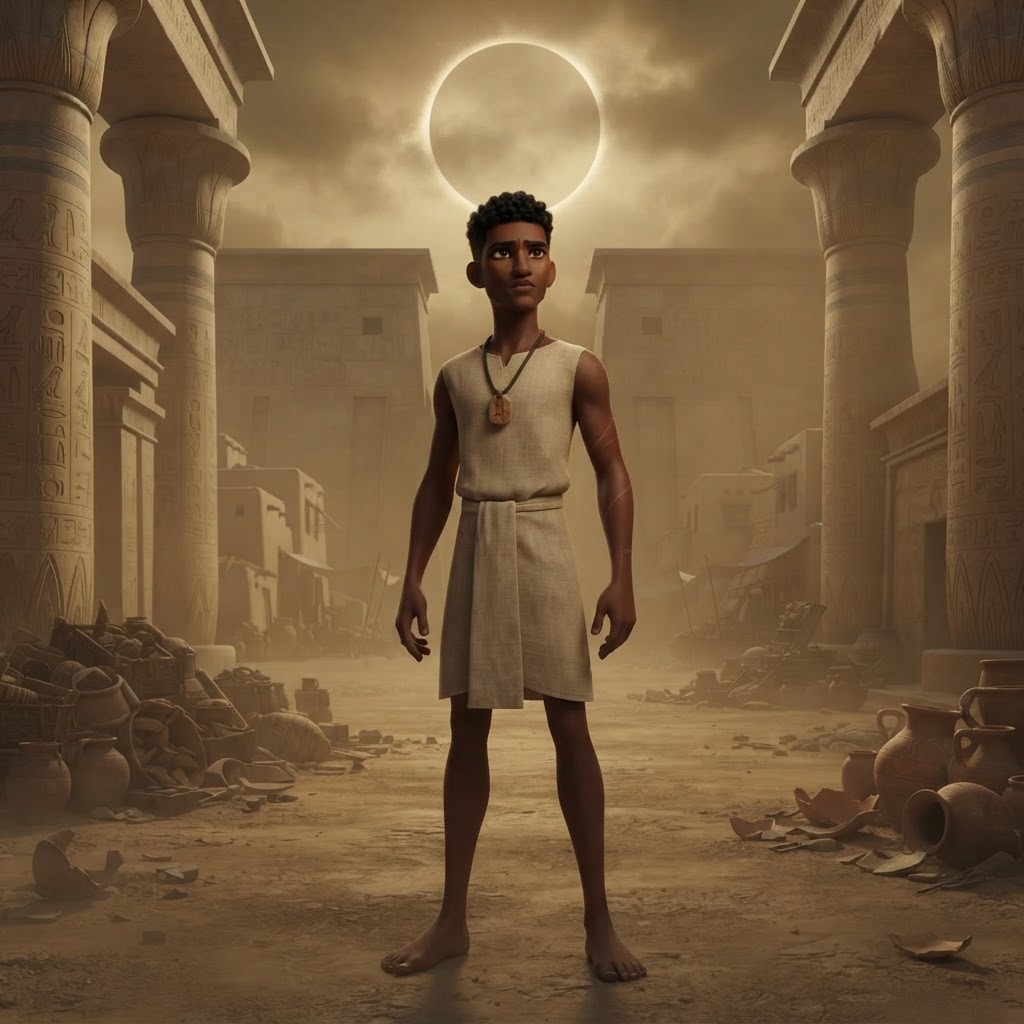
Keeper of the Sun

by D D
In the shadow of a dying sun, a desperate guardian must traverse the blistering sands to reignite the light before eternal darkness consumes the empire.
3D Animation
adventure
111
Translate this story
Manuscript
Egypt, circa 1400 BCE
The morning the sun weakened, Khepri was standing on the eastern roof of the Temple of Ra with a clay lamp in one hand and a bronze scraper in the other.
Below him, the city of Waset slowly awakened beside the Nile. Mud-brick homes crowded along narrow streets. Bakers carried warm loaves from smoking ovens. Merchants raised striped awnings over stalls filled with dates, figs, linen, copper tools, and jars of fragrant oil. Donkeys complained beneath heavy baskets while fishermen pushed reed boats into the dark water.
Everything appeared ordinary.
Yet the light was wrong.
The sun rose above the desert hills as a pale bronze circle instead of a blazing golden disk. Its rays touched the temple columns without warmth, and long shadows remained stretched across the courtyard as though dawn had stopped halfway through arriving.
Even the birds seemed unsettled.
Usually, flocks of white ibises crossed the sky at sunrise. On this morning, only one bird flew over the temple. It circled twice, released a sharp cry, and vanished toward the western cliffs.
Khepri lowered the lamp.
At nineteen, he was one of the youngest apprentices permitted inside the temple’s inner chambers. He stood slightly taller than most men his age, with long limbs, a narrow waist, and shoulders strengthened by years of carrying scroll chests and stone tablets. His skin was a deep brown polished by desert sun, and his black hair formed tight curls cut close around the sides but left thicker at the crown. A thin scar crossed his left forearm, pale against his skin, the result of climbing a half-built monument when he was twelve.
His face often betrayed his thoughts. His dark amber eyes narrowed whenever he sensed a lie, and his full mouth twisted slightly whenever someone told him not to ask questions.
This morning, his expression was troubled.
“You are supposed to be cleaning the solar plates,” said a dry voice behind him.
Khepri turned.
High Priest Hori stepped through the roof entrance with both hands folded inside the sleeves of his white linen robe. He was nearly eighty, though his posture remained straight. His narrow face was framed by a long silver beard divided into two braids, and his dark scalp was completely shaved except for a faint fringe above his ears. Age had softened his body but not his gaze. His eyes remained sharp and black, like polished stones at the bottom of a river.
Khepri looked toward the horizon again.
“The light is weaker.”
Hori came to stand beside him. “You noticed.”
“The entire city noticed.”
“The city notices many things. It understands very few.”
Khepri glanced at the old priest. “Do you understand it?”
Hori did not answer immediately.
In the courtyard below, temple workers began moving a massive statue of Ra into position for the morning ceremony. The statue had the body of a man and the head of a falcon, crowned by a golden sun disk. Even the gold seemed dull beneath the weak sky.
“The Nile has fallen for twelve days,” Khepri said. “Farmers near the southern gate say the soil is beginning to crack. Yesterday, I saw three dead fish floating near the docks.”
“You have been listening to rumors again.”
“I have been listening to people.”
“That can be even more dangerous.”
Khepri set down the scraper.
“Something is wrong.”
Hori studied him for a long moment. Then he looked toward the fading sun.
“Yes,” he said quietly. “Something is wrong.”
Before Khepri could ask another question, a deep horn sounded from the temple courtyard.
The morning ceremony was beginning.
Hori turned away.
“You will stand beside the second column today. Do not speak unless spoken to.”
“That usually means you expect something to happen.”
“It means I expect you to follow instructions.”
Khepri watched him disappear into the stairway.
That was not an answer.
It was rarely an answer.
By midday, the heat should have been punishing.
Instead, a cool wind moved through the market.
Princess Neferura walked beneath a plain linen head covering, dressed in the simple cream-colored robe of a merchant’s daughter. Only the quality of the fabric and the gold thread around her sandals hinted that she belonged to the royal household.
She was twenty-three, tall and slender, with smooth copper-brown skin and an oval face marked by high cheekbones and wide hazel eyes. Her black hair had been braided into dozens of narrow plaits that fell to the middle of her back. Small gold beads decorated the ends, clicking softly when she walked.
Two palace guards followed at a distance, disguised as laborers. Neferura had ordered them not to approach unless she was in danger.
She preferred hearing people speak when they did not know a princess was listening.
Near a pottery stall, an elderly farmer argued with a merchant over the price of grain.
“You ask three times what you asked last month,” the farmer complained.
“Then blame the river,” said the merchant. “Not me.”
“My fields are dry.”
“So are everyone else’s.”
At another stall, a woman held a feverish child while asking a healer for herbs she could not afford.
Beyond them, two fishermen whispered about the strange sky.
“The sun god has turned his face from us,” one said.
“The priests say the ceremonies will restore his favor.”
“The priests always say ceremonies will restore something.”
Neferura stopped near a spice table and pretended to examine a bowl of saffron.
“What do you think?” asked a familiar voice.
She looked up.
General Menes stood on the opposite side of the stall.
Unlike Neferura, he made no attempt to hide who he was.
Menes was in his early forties, broad across the chest and thick through the arms. His skin was dark bronze, and his head was shaved completely smooth. A carefully trimmed black beard framed a strong jaw. His nose had been broken in battle years earlier and healed slightly crooked, giving his otherwise handsome face a permanent severity.
He wore a red military cloak over polished leather armor reinforced with bronze plates. A curved sword hung from his hip. Two soldiers waited behind him.
The spice merchant immediately bowed.
Neferura did not.
“What do I think about what?” she asked.
“The city.”
“It is afraid.”
“Fear is useful.”
“To soldiers, perhaps.”
“To rulers as well.”
Menes picked up a date from a nearby tray and examined it before placing it back.
“The people need reassurance,” he said. “The palace should announce that the Nile will recover.”
“You want my father to promise control over the river?”
“I want the Pharaoh to appear strong.”
Neferura’s eyes narrowed.
“My father is ill, not weak.”
“I did not say otherwise.”
“You did not have to.”
Menes smiled faintly.
He had served her father for nearly twenty years and had won victories along Egypt’s southern border. Statues had been raised in his honor. Songs were sung about him in military camps.
Yet Neferura had never trusted him.
Menes admired obedience too much.
“Come to the temple tonight,” he said. “The priests will conduct a private ceremony for the royal court.”
“I was not informed.”
“Perhaps the message was delayed.”
“Messages to the royal family are rarely delayed.”
For the first time, his smile disappeared.
A horn sounded from the direction of the palace.
Menes bowed.
“Until tonight, Princess.”
He walked away, soldiers following.
Neferura watched him vanish into the crowd.
The spice merchant leaned closer and lowered his voice.
“He frightens me.”
Neferura glanced at him.
“You should be more careful saying such things.”
The merchant paled.
Neferura placed two silver pieces on the table.
“But you are not alone.”
At the temple, Khepri spent the afternoon cleaning soot from painted walls in a storage chamber beneath the main sanctuary.
The room was packed with ceremonial objects: carved staffs, alabaster bowls, broken statues, faded banners, and wooden chests sealed with hardened wax. Dust floated through thin shafts of light.
Khepri was supposed to work alone.
Instead, his friend Sabit sat on an overturned basket eating a fig.
Sabit was eighteen and built almost entirely from elbows, knees, and nervous energy. His reddish-brown skin was covered in freckles, and a cloud of loose black curls framed his thin face. He had large eyes, prominent ears, and an unfortunate habit of whispering loudly.
“You heard what happened near the southern farms?” Sabit asked.
“No.”
“Goats died.”
“Goats die every day.”
“All at once?”
Khepri paused.
“How many?”
“Twenty, maybe thirty. My cousin said their eyes were cloudy.”
“Your cousin also said he saw a crocodile with two heads.”
“He had been drinking palm wine that day.”
“He drinks palm wine every day.”
Sabit took another bite.
“You think the gods are angry?”
“I think frightened people blame the gods before looking for real causes.”
“That sounds like something that gets apprentices thrown out of temples.”
“Then stop repeating it.”
Khepri moved toward a row of old scroll boxes.
One chest had been pulled slightly away from the wall.
He crouched.
Fresh scratches marked the stone floor.
Someone had moved it recently.
Khepri pushed the chest aside and discovered a narrow gap behind it. Cold air drifted through the opening.
Sabit slid off the basket.
“What is that?”
“A passage.”
“You should close it.”
“You have never said anything less surprising.”
Khepri pressed his shoulder against the chest until the gap widened.
Behind it was a doorway no higher than his chest. The stone had been painted to resemble the wall, but age had caused the colors to crack.
A symbol had been carved above the opening.
A sun disk divided by a vertical line.
Sabit’s mouth fell open.
“I have never seen that symbol.”
“I have.”
“Where?”
Khepri reached beneath his robe and removed a small clay token hanging from a cord around his neck. The token had belonged to his mother, who died when he was an infant. The same divided sun was carved into its surface.
He had spent years asking priests what it meant.
No one had ever answered.
Khepri stared into the passage.
“Bring the lamp.”
Sabit shook his head. “Absolutely not.”
“Then wait here.”
“That is worse.”
They entered together.
The passage sloped downward through cramped darkness. The walls were older than the temple above them, built from rough stone blocks rather than polished limestone. Strange carvings lined both sides: priests raising mirrors toward the sky, men carrying crystals, and a figure with a falcon’s head standing before a circle of flames.
Sabit held the lamp with trembling hands.
“This place should not exist.”
“Most places exist whether we know about them or not.”
“That sounded wise.”
“I heard Hori say it.”
They reached a circular chamber.
In its center stood a stone table covered with a decayed linen cloth.
Khepri pulled it away.
Beneath the cloth was a map.
It showed the Temple of Ra, the palace, the Nile, and the western desert. Several lines extended from the temple toward a cluster of hills beyond the city. Small symbols shaped like mirrors had been carved along the route.
At the center of the map was a larger symbol.
The divided sun.
Sabit pointed to an inscription.
“Can you read it?”
Khepri leaned closer.
The writing was ancient but familiar enough to understand.
“‘The light that gives life may also blind the world.’”
“That does not sound comforting.”
Khepri noticed blue dust gathered in the grooves of the map.
He touched it with one finger.
The powder glittered.
“What is that?” Sabit whispered.
Before Khepri could answer, footsteps echoed from the passage.
Someone was coming.
Khepri extinguished the lamp.
Darkness swallowed the room.
Sabit grabbed his arm hard enough to hurt.
A faint light appeared in the tunnel.
Two men entered the chamber carrying oil lamps.
Khepri and Sabit crouched behind the stone table.
One man wore the white robe of a temple priest. The other wore military sandals and a short red cloak.
Khepri could not see their faces clearly.
“The preparations are nearly complete,” said the soldier.
“The High Priest suspects something,” the priest replied.
“Hori suspects everything. He proves nothing.”
“And the apprentice?”
Khepri stopped breathing.
“He asks questions.”
“Then make sure he receives no answers.”
The soldier placed something on the map.
A small bronze seal.
Even in the dim light, Khepri recognized the symbol stamped into it.
A jackal beneath a spear.
General Menes’ personal insignia.
The men left.
Khepri waited until their footsteps disappeared.
Then he relit the lamp.
Sabit looked ready to collapse.
“They were talking about you.”
“I know.”
“We should tell Hori.”
“Not yet.”
“Not yet?”
Khepri picked up the bronze seal.
“If Menes is involved, we need more than a hidden room and a conversation no one else heard.”
Sabit stared at him.
“You are going to investigate the most powerful general in Egypt.”
“Yes.”
“You are insane.”
“Probably.”
That evening, hundreds of lamps burned inside the Temple of Ra.
The royal court gathered beneath towering painted columns while priests chanted around the sacred altar. Incense filled the hall with clouds of cedar and myrrh.
Princess Neferura entered beside her younger brother, Prince Setau.
Setau was sixteen, round-faced and cheerful, with warm brown skin and shoulder-length braids tied behind his head. He wore a blue ceremonial robe and looked more interested in the food being prepared for the feast than the ceremony itself.
“Why does every prayer require standing?” he whispered.
“Because the gods dislike comfortable people,” Neferura replied.
Setau covered a laugh.
At the far end of the hall, General Menes stood beside the royal council.
High Priest Hori approached the altar.
Khepri watched from behind the second column, exactly where he had been ordered to stand.
The altar held Egypt’s most sacred relic.
The Heart of Ra.
It was a crystal the size of a man’s head, shaped like a teardrop and set inside a frame of gold. By day, it appeared clear. Beneath torchlight, golden fire seemed to move within it.
According to temple legend, the crystal had fallen from the sun itself.
Khepri doubted that.
But he did not doubt its importance.
Hori raised both hands.
“Ra, who crosses the sky in his sacred vessel, look upon your people.”
The chanting grew louder.
The lamps flickered.
Then every flame in the hall went out.
Darkness fell.
People gasped.
Someone screamed.
Khepri heard sandals scraping stone. A body struck one of the columns. Metal rang against the floor.
Then a single golden flash illuminated the sanctuary.
For an instant, Khepri saw a figure standing near the altar.
A red cloak.
A raised arm.
Blue dust falling from a gloved hand.
The light vanished.
Moments later, servants relit the lamps.
The altar was empty.
The Heart of Ra was gone.
Chaos erupted.
Guards sealed the doors.
Priests dropped to their knees.
Members of the royal court shouted accusations.
General Menes strode toward the altar with his sword drawn.
“No one leaves this temple!”
His voice echoed through the hall.
Neferura moved closer to the empty golden frame.
“There was no time for anyone to reach the doors,” she said.
Menes looked at her.
“Then the thief is still inside.”
Khepri stepped from behind the column.
“No.”
Every head turned toward him.
Hori’s expression hardened.
Khepri approached the altar and knelt.
Blue powder glittered across the stone.
“The thief left before the lamps were relit,” he said.
Menes’ jaw tightened.
“Explain yourself.”
Khepri held up one dust-covered finger.
“This came from a hidden passage beneath the temple.”
Whispers moved through the crowd.
Hori stared at him.
Neferura stepped closer.
“You found a passage?”
“And a map leading into the western desert.”
Menes lowered his sword slightly.
“What else did you find?”
Khepri met his eyes.
“A military seal.”
Silence spread through the sanctuary.
Khepri reached beneath his robe.
His hand closed around the bronze seal.
Before he could reveal it, a blade flew through the air.
Khepri twisted aside.
The knife struck the column beside his head.
People screamed again.
A hooded figure ran toward the rear of the temple.
“Stop him!” Neferura shouted.
Khepri chased the figure through the crowded hall, knocking aside overturned lamps and startled nobles. The stranger disappeared behind a statue of Ra.
Khepri followed.
A stone panel stood open behind the statue.
Beyond it waited a dark staircase descending beneath the temple.
Khepri hesitated only once.
Then he stepped into the darkness.
Behind him, Princess Neferura appeared holding a lamp.
“You are not going alone,” she said.
Khepri looked back toward the chaos in the sanctuary.
General Menes stood near the altar, watching them.
His face revealed nothing.
But his right hand was stained with blue dust.
Khepri turned toward the hidden staircase.
Somewhere beneath the temple, the thief was escaping with the Heart of Ra.
And somewhere beyond the walls of Waset, a plan had already begun to steal more than a sacred relic.
Someone intended to steal the sun itself.
The hidden staircase descended farther than Khepri expected.
Its steps had been cut unevenly into the stone, some barely wide enough for his feet. The walls pressed close on both sides, damp with underground moisture. Behind him, Princess Neferura carried the lamp while Sabit, who had ignored every sensible instinct and followed them, struggled to keep from slipping.
The sounds of panic in the temple faded above.
Soon, there was only the scrape of sandals, the hiss of the lamp, and the distant echo of running footsteps.
“The thief is still ahead,” Khepri whispered.
“How can you tell?” Sabit asked.
Khepri pointed toward the ground.
Blue dust marked the steps.
Neferura raised the lamp higher. “The same powder from the altar.”
“And from the chamber beneath the storage room,” Khepri said.
The passage curved sharply before opening into a long tunnel supported by ancient cedar beams. Several had cracked with age. Sand trickled from the ceiling each time someone moved overhead.
Ahead, a shadow crossed the lamplight.
Khepri ran.
The hooded thief glanced back and threw something onto the ground.
A clay jar shattered.
Oil spread across the passage.
The thief tossed a flame behind him.
Fire exploded across the tunnel.
Khepri stopped so suddenly that Neferura collided with his back.
Heat rushed toward them.
Sabit shouted, “We are trapped!”
Khepri searched the walls.
Carvings covered the stone—boats, stars, birds, and the divided sun symbol he had seen on his mother’s token.
The vertical line in the symbol pointed downward.
He dropped to his knees and pressed both hands against the lowest stones.
One shifted.
“Help me!”
Neferura knelt beside him.
Together they pushed until a section of wall collapsed inward, revealing a narrow drainage channel.
Smoke filled the tunnel.
“There!” Khepri shouted.
They crawled through the opening one at a time as flames rolled overhead.
The channel was barely large enough for their bodies. Mud soaked their clothing, and insects scattered through the darkness. Behind them, part of the burning tunnel collapsed with a roar, sealing the way back.
Sabit coughed.
“I would like it remembered that I never agreed to this.”
“You followed us,” Neferura said.
“I followed out of loyalty. It was a poor decision.”
Khepri almost smiled.
The channel ended at a rusted bronze grate.
He kicked it twice.
The grate fell outward.
All three tumbled onto a stone ledge overlooking the Nile.
Night had settled over Waset.
The city glowed with thousands of lamps, while the river reflected the pale moon. Directly below them, a narrow boat moved silently away from the temple wall.
The hooded thief stood at its rear.
A cloth-covered object rested at his feet.
The Heart of Ra.
“He has it,” Neferura said.
Khepri spotted three small fishing boats tied beneath the ledge.
They climbed down a rope ladder and landed in the nearest one.
Sabit grabbed an oar.
“I do not know how to row.”
“Then learn quickly,” Khepri said.
They pushed into the current.
The thief’s boat moved south, guided by two rowers dressed in dark clothing. Khepri and Sabit paddled while Neferura held the lamp low to avoid drawing attention.
The Nile carried them past sleeping homes, temple docks, and reed-covered banks. Crocodile eyes glimmered near the shoreline. Somewhere in the darkness, a hippopotamus released a deep, rumbling call.
The thief looked back.
He drew a bow.
Neferura saw it first.
“Down!”
An arrow passed over Khepri’s head and struck the water.
A second pierced the side of their boat.
Water began leaking through the wood.
Sabit stared at the hole.
“That seems bad.”
“Keep rowing.”
Another arrow flew.
Neferura lifted a wooden storage lid as a shield. The arrow struck it with enough force to split the edge.
Their boat gained on the thief.
Khepri could see the stolen crystal beneath the cloth. Even covered, it gave off a faint golden glow.
The thief’s boat turned sharply toward a canal lined with tall reeds.
Khepri followed.
The canal narrowed until the reeds brushed both sides of their boat. The city vanished behind them.
Then the thief’s boat stopped.
Khepri realized why too late.
A rope stretched across the water.
Their boat struck it.
Khepri, Neferura, and Sabit were thrown forward.
The lamp disappeared into the canal.
Darkness swallowed them.
Men emerged from the reeds.
Hands grabbed Khepri and dragged him from the boat. He struck one attacker in the jaw but another clubbed him across the back.
Neferura fought fiercely, driving her elbow into a man’s throat before two others restrained her.
Sabit bit someone.
The resulting scream echoed across the canal.
A torch flared.
The hooded thief stood on the bank.
He pulled back his covering.
Khepri recognized him.
Priest Natek.
Natek had served in the Temple of Ra for more than fifteen years. He was short and heavyset, with a bald head, pale brown skin, and a black ceremonial line painted beneath each eye.
Khepri remembered seeing him lead prayers for honesty.
“You,” Khepri said.
Natek looked ashamed for only a moment.
Then he hardened his expression.
“You should have stayed in the sanctuary.”
Neferura struggled against the men holding her.
“You stole from the gods.”
Natek laughed bitterly.
“The gods do not own the Heart.”
“Then who does?”
“The one strong enough to use it.”
A rider approached along the bank.
The men bowed.
General Menes entered the torchlight.
His red cloak moved behind him in the night breeze.
He looked at Khepri, then at Neferura.
“You have made this more difficult than necessary.”
Neferura’s hazel eyes burned with anger.
“You extinguished the lamps.”
Menes removed his riding gloves.
“Natek extinguished the lamps.”
“But you ordered it.”
Menes did not deny it.
Khepri looked toward the wrapped crystal.
“Why?”
Menes stepped closer.
“Because Egypt is dying under weak rulers and frightened priests.”
“My father has held this kingdom together for decades,” Neferura said.
“Your father is confined to his bed while the Nile shrinks and foreign rulers gather at our borders.”
“You caused the fields to weaken.”
“I revealed how helpless the throne truly is.”
Menes gestured toward the western desert.
“By tomorrow, the sun will fade further. Within days, the people will demand salvation.”
“And you will offer it,” Khepri said.
Menes smiled.
“The people do not follow truth. They follow whoever ends their fear.”
He ordered the prisoners placed into separate wagons.
The Heart of Ra was carried away under heavy guard.
Before Khepri was thrown into the rear of a wagon, Menes removed the bronze seal from his hand.
“You should not take things that do not belong to you.”
Khepri met his gaze.
“You did.”
Menes struck him across the face.
The world blurred.
The wagon began moving west.
Khepri awoke before dawn.
His wrists were tied behind him. A coarse sack covered his head, and each turn of the wagon threw his shoulder against the wooden side.
He listened carefully.
The wheels rolled over stone rather than sand.
They were climbing.
From another wagon, he heard Sabit complaining loudly.
“My hands are losing all feeling. If my hands fall off, I will hold every one of you responsible.”
A guard told him to be quiet.
Sabit continued.
Khepri heard Neferura’s voice farther ahead.
She was arguing with Menes.
Good.
They were alive.
Khepri pressed his mother’s clay token against the rope around his wrists. One edge had broken years earlier, leaving a small sharp point.
He worked it against the rope.
The wagon slowed.
Voices echoed around them.
They had entered the quarry.
By the time the sack was pulled from his head, the rope around Khepri’s wrists was nearly severed.
The abandoned limestone quarry stretched beneath the western cliffs like an enormous wound in the desert.
Only now it was filled with workers.
Hundreds of polished bronze mirrors stood on wooden platforms at different angles. Some were taller than men. Others formed long rows leading toward a circular pit at the center of the quarry.
Crystals had been mounted between the mirrors.
Blue dust covered the ground.
Khepri finally understood what it was.
Crushed lapis and copper salts had been mixed into a reflective coating, allowing the surfaces to scatter light with an unnatural blue shimmer.
The Heart of Ra was carried toward the central pit.
Neferura was brought beside Khepri. Her lower lip was bleeding, but she stood straight and proud.
Sabit arrived last, limping dramatically.
“I may never walk properly again.”
“You walked ten steps,” Khepri said.
“They were difficult steps.”
General Menes approached the edge of the pit.
Below it, sunlight entered through a narrow opening in the eastern cliff. The mirrors redirected the beam from platform to platform until it struck the Heart of Ra.
The crystal erupted with golden light.
Workers shielded their eyes.
A brilliant column shot upward through an opening in the quarry roof.
Far beyond the cliffs, the light would appear as if the sun itself were burning inside the desert.
Neferura stared at the machinery.
“You have been diverting sunlight from the valley.”
“Only a fraction,” Menes said.
“Enough to cool the fields and frighten the people.”
“Fear requires only a small beginning.”
Khepri studied the mirror platforms.
Some faced east.
Others faced toward Waset.
Menes intended to project the Heart’s light above the city.
A false sunrise.
A miracle.
“When?” Khepri asked.
Menes looked toward the sky.
“Tomorrow, during the eclipse.”
Sabit blinked. “The eclipse?”
Natek stepped forward.
“The temple records predicted it.”
Menes smiled.
“When darkness covers Egypt, I will stand before the people holding the Heart of Ra. Then I will command the sun to return.”
Neferura shook her head.
“You will murder anyone who knows the truth.”
“Not anyone.”
Menes looked at her.
“You are the daughter of Pharaoh. When you tell the people that Ra chose me, they will believe you.”
“I would rather die.”
“That can be arranged.”
Khepri looked at Hori’s map in his mind.
The divided sun.
The mirror symbols.
The warning carved beneath the temple.
His mother’s token was not merely decorative.
It was a key to the old system.
Someone in his family had known about this place.
Perhaps they had guarded it.
Menes ordered Natek to lock them inside a storage chamber cut into the cliff.
The room was windowless, with a heavy wooden door and one narrow opening near the ceiling.
Once the guards left, Khepri finished cutting the rope around his wrists.
Sabit stared.
“You could have done that earlier?”
“I was waiting until we knew where they were taking us.”
Neferura untied herself, then Sabit.
“Can we escape through the opening?” she asked.
Sabit looked up.
“Perhaps if I remove my bones.”
Khepri examined the walls.
The divided sun appeared again near the floor.
He pressed his token into the carving.
It fit perfectly.
A click sounded inside the stone.
Part of the wall shifted.
Neferura looked at him.
“What is that token?”
“It belonged to my mother.”
“You never told me she was connected to the temple.”
“I did not know.”
The hidden panel opened onto an ancient corridor.
They entered and closed it behind them.
The passage led upward through the cliff.
Painted scenes covered the walls, preserved by the dry air. They showed generations of guardians operating the mirror system.
One mural depicted the Heart of Ra being used to guide travelers during sandstorms.
Another showed priests directing sunlight into underground gardens.
The mirrors had once been built to protect life.
Menes had turned them into weapons.
At the end of the passage, Khepri found an inscription beneath an image of a woman holding the divided sun.
He raised the lamp.
Her face had the same narrow eyes and high cheekbones as his own.
Beneath her image were the words: Merit, Keeper of the Sun.
Khepri touched the painted figure.
“My mother.”
Neferura stood beside him.
“She was a guardian.”
“I was told she died from illness.”
“Perhaps Hori was protecting you.”
“Or lying to me.”
A noise echoed through the passage.
Guards had discovered the open chamber.
There was no time for more questions.
They climbed until they emerged on a ledge overlooking the entire quarry.
Below, workers adjusted the mirrors for the eclipse.
Neferura pointed toward a line of horses near the northern entrance.
“If we reach them, we can return to Waset.”
Sabit looked down the steep slope.
“We could also fall and become part of the quarry.”
Khepri studied the mirror supports.
A system of ropes connected the wooden platforms. Cutting one would rotate several mirrors at once.
He picked up a discarded copper tool.
“We are not leaving yet.”
Neferura followed his gaze.
“You want to destroy the system.”
“I want to make sure Menes cannot perform his miracle.”
They separated.
Sabit crawled toward the horse enclosure.
Neferura moved along the upper ledge, loosening support pins.
Khepri descended between the mirror platforms.
Workers were changing shifts, and the growing darkness helped conceal him.
He reached the central platform.
The Heart of Ra rested inside a gold frame guarded by four soldiers.
Khepri could not take it by force.
But he did not need to.
He found the main alignment rope and cut halfway through it.
It would hold for now.
Under pressure, it would snap.
A shout rose from the cliff.
Sabit had reached the horses.
Unfortunately, he had also released all of them.
Dozens of frightened animals thundered through the quarry.
Workers scattered.
Mirrors shook.
Neferura pulled the pins from the upper platform.
Three enormous reflectors swung out of alignment.
Khepri ran.
Menes appeared near the central pit.
“Stop them!”
Soldiers poured into the quarry.
Khepri climbed onto a moving platform as arrows struck the wood around him.
Neferura jumped from the ledge onto a stack of limestone blocks. Khepri reached for her as she slipped.
Their hands locked.
He pulled her onto the platform.
A horse raced past below.
Sabit clung to its neck, shouting apologies to the animal.
Khepri and Neferura leaped onto the horse as it passed.
They rode from the quarry beneath a storm of arrows.
Behind them, General Menes stood among the misaligned mirrors.
His roar followed them into the desert.
They reached Waset shortly before sunrise.
The city gates were closed.
Menes had already sent word ahead, accusing Neferura of conspiring with thieves and claiming Khepri had stolen the Heart of Ra.
Royal guards surrounded them.
Prince Setau pushed through the soldiers.
He embraced his sister.
“You are alive.”
“For now.”
High Priest Hori emerged from the gate.
Khepri’s relief quickly turned to anger.
He held up the clay token.
“You knew.”
Hori’s face changed.
“You found the chamber.”
“I found my mother’s name.”
Hori dismissed the guards and led them into a small gatehouse.
There, Khepri told him everything.
When he finished, Hori sat heavily.
“Your mother did not die from illness,” the old priest said.
Khepri’s hands tightened.
“She discovered Menes searching the old records. He wanted the mirror system even then.”
“He killed her?”
“Natek betrayed her location. Menes’ soldiers followed her into the desert.”
“And you hid the truth from me.”
“I hid you. You were an infant. If Menes had known you carried the guardian token, he would have killed you as well.”
Khepri looked away.
He wanted to hate Hori.
Part of him did.
But the larger part understood.
Neferura placed both hands on the table.
“The eclipse begins at midday. Menes still has the Heart.”
“He will enter the city as a savior,” Hori said.
“Then we expose him before he performs the miracle,” Khepri replied.
“Words will not be enough.”
Khepri remembered the weakened rope.
“They will be when his miracle fails.”
By midday, nearly every citizen of Waset had gathered outside the Temple of Ra.
The eclipse had begun.
A dark curve moved across the sun.
People prayed in the streets. Mothers held children close. Merchants abandoned their stalls. Soldiers watched the sky with fear they tried to hide.
Then horns sounded from the western road.
General Menes entered the city in a golden chariot.
Behind him, soldiers carried the Heart of Ra.
The crystal blazed with concentrated light gathered from the quarry mirrors.
The crowd fell silent.
Menes climbed the temple steps.
“People of Egypt!” he shouted. “Your rulers have failed you. Your priests have hidden from the truth. But Ra has chosen a new protector.”
The eclipse deepened.
Day became twilight.
Menes raised the Heart above his head.
Golden light streamed from it.
The crowd gasped.
Some bowed.
Khepri stepped onto the temple balcony.
“He is lying!”
Menes looked up.
Soldiers moved toward Khepri, but Neferura appeared beside him wearing her royal blue gown and golden crown.
The soldiers stopped.
Neferura’s voice carried across the plaza.
“General Menes stole the Heart of Ra. He weakened the fields with hidden mirrors and created fear so he could seize the throne.”
Menes laughed.
“Then explain the light in my hands.”
Khepri looked toward the western cliffs.
The eclipse reached its fullest point.
Far away, darkness covered the quarry.
The mirrors lost their source.
The Heart of Ra dimmed.
Menes stared at it.
“No.”
The half-cut rope in the quarry finally snapped.
The main mirrors rotated in different directions.
A sudden beam of concentrated light shot across the western sky, illuminating the mirror towers for everyone in Waset to see.
Hundreds of bronze surfaces glittered along the cliffs.
The deception was exposed.
The crowd began shouting.
Menes threw the crystal aside and drew his sword.
His soldiers hesitated.
“Arrest them!” he ordered.
No one moved.
Natek tried to escape through the temple doors, but Sabit blocked his path with a ceremonial staff.
“I have had an extremely unpleasant night,” Sabit said. “You are not making it worse.”
Menes charged up the steps toward Neferura.
Khepri met him halfway.
Menes swung his sword.
Khepri blocked it with the bronze staff Hori tossed from the balcony.
The impact nearly tore the staff from his hands.
Menes attacked again.
He was stronger, faster, and trained for war.
Khepri retreated between the temple columns, barely avoiding each strike.
“You think questions make you wise?” Menes snarled.
“No,” Khepri said. “Answers do.”
Menes drove him against the altar.
The sword rose.
Khepri noticed sunlight returning at the edge of the eclipse.
A narrow beam struck the Heart of Ra where it lay on the temple floor.
The crystal reflected light into Menes’ eyes.
He staggered, blinded.
Khepri swept the staff behind his knees.
Menes fell.
His sword slid across the stones.
Royal guards surrounded him.
This time, when he ordered them to stand aside, they ignored him.
Princess Neferura descended the steps.
“General Menes, you are charged with treason against Pharaoh, the royal family, and the people of Egypt.”
Menes looked toward the crowd that had once celebrated his victories.
No one bowed.
No one cheered.
The eclipse passed.
Sunlight returned to Waset.
Warmth spread across the plaza.
For the first time in weeks, birds crossed the sky.
In the days that followed, soldiers dismantled the mirrors in the western quarry.
The Heart of Ra was returned to the temple, though Hori ordered it sealed inside a chamber that no ruler or priest could enter alone.
Natek confessed to helping Menes and revealed the names of every official involved in the conspiracy.
The irrigation channels were reopened. Farmers returned to the fields. The Nile remained low for a time, but the fear surrounding it began to fade.
Menes had never controlled the river.
He had only controlled what people believed about it.
One morning, Khepri stood once again on the eastern roof of the Temple of Ra.
The sun rose bright and golden over Waset.
Hori joined him.
For a while, neither spoke.
Then the old priest held out a new pendant.
It was made of gold and shaped like a sun divided by a single vertical line.
“Your mother wore this before you were born.”
Khepri accepted it.
“Was she brave?”
“She was stubborn, impatient, suspicious of authority, and incapable of leaving a mystery alone.”
Khepri smiled.
“So she was brave.”
“Yes.”
Princess Neferura climbed onto the roof, followed by Sabit, who carried a basket of figs he had almost certainly stolen from the temple kitchen.
“My father has asked Khepri to serve as an adviser to the royal court,” she announced.
Sabit nearly dropped the basket.
“Him?”
Khepri raised an eyebrow.
“I meant congratulations,” Sabit said quickly.
Khepri looked toward the city.
He could see children running near the river, fishermen lifting their nets, workers crossing the temple courtyard, and merchants opening their stalls beneath the morning light.
“I am still an apprentice.”
Hori shook his head.
“Not anymore.”
He fastened the golden pendant around Khepri’s neck.
“The old guardians protected the mirrors, the crystal, and the knowledge of light.”
“But the mirrors were destroyed.”
“Objects can be rebuilt.”
Hori placed a hand on his shoulder.
“What matters is who guards the truth.”
Below, the temple bells rang.
Not in warning.
In celebration.
The sound traveled across Waset, over the Nile, and into the desert where the last of Menes’ false suns were being torn down.
Khepri looked into the blazing eastern sky.
For years, he had wondered why his mother left him the divided sun.
Now he understood.
It had never been a symbol of power.
It was a reminder.
Light could reveal truth.
Light could also be bent, reflected, and used to deceive.
The world would always need someone willing to tell the difference.
From that day forward, Khepri served beside Princess Neferura, protecting Egypt not through fear or force, but through knowledge.
The people called him the apprentice who exposed a general.
The priests called him the heir of an ancient order.
Children told stories about the young man who chased a thief beneath the Nile and restored the morning to Egypt.
But history remembered him by the title once carried by his mother.
Khepri, the Keeper of the Sun.
38 scenes
Comments(1)
Create a Storylife account to comment
Join the community to share your thoughts on this story.
- TTheGreatestEver8/5/2026
Dope story!