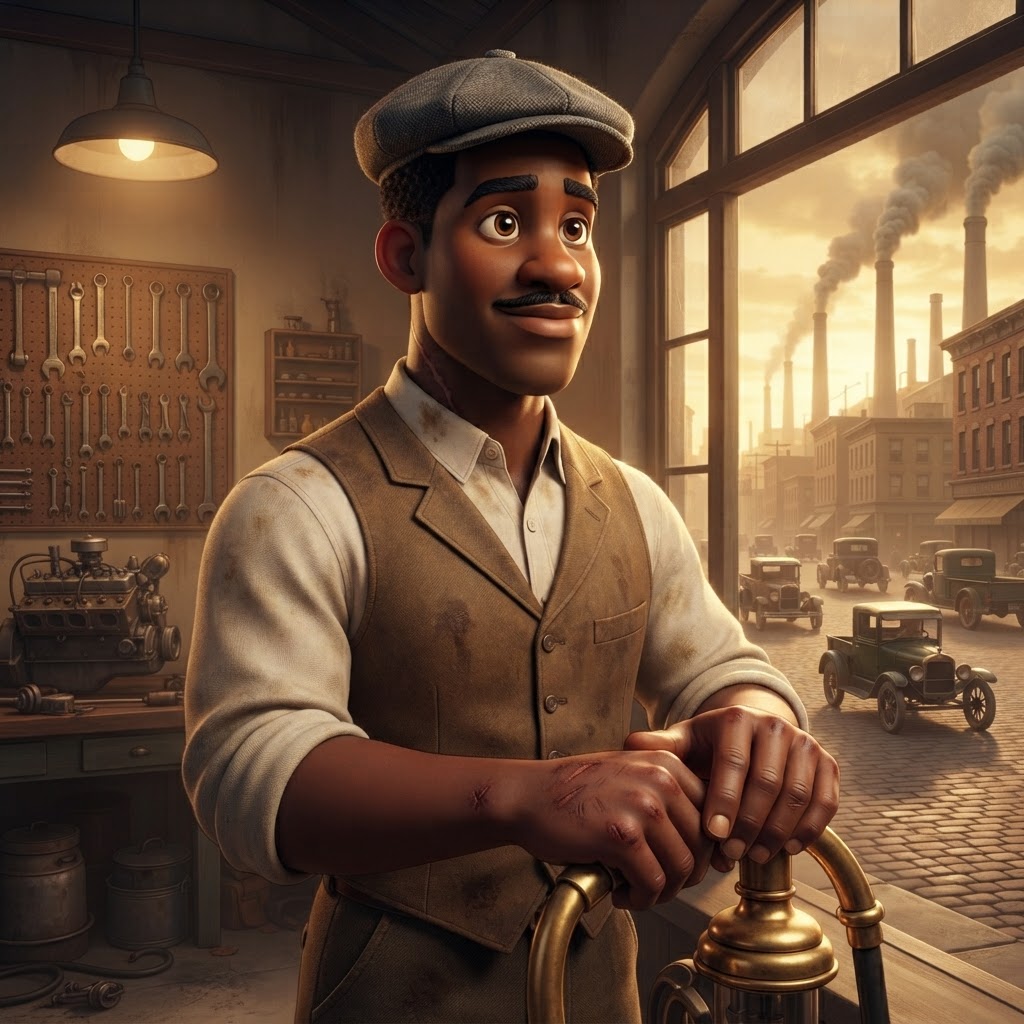
The Garage on Hastings Street

by D D
A determined mechanic struggles to transform his modest Detroit garage into a hub of innovation, holding fast to the belief that his hard work will eventually change his family's future.
3D Animation
drama
111
Translate this story
Manuscript
The Garage on Hastings Street
In the summer of 1927, Detroit seemed to breathe smoke.
Factory chimneys poured gray clouds over the city from sunrise until long after dark. Automobile plants shook the ground with the pounding of machinery, and newly built Model Ts crowded streets that had once belonged mostly to horses and streetcars. Men arrived by train every day looking for factory work. Families packed into narrow apartments, boardinghouses, and rented rooms. Everywhere August Whitmore looked, the city appeared to be building itself faster than anyone could understand it.
August stood on Hastings Street with one hand resting on the rusted handle of a wooden garage door.
At thirty-two years old, he was difficult to overlook. He stood six feet four inches tall, with broad shoulders made wider by years of carrying lumber in Mississippi sawmills. His skin was a deep walnut-brown, and his square face was framed by high cheekbones, a strong chin, and a carefully trimmed black mustache. His tightly coiled hair was cut close beneath a gray newsboy cap. A narrow pale scar ran from beneath his right ear toward the back of his neck, partly hidden by the stiff white collar of his shirt.
His large hands were his most noticeable feature. The knuckles were thick, and the palms were covered with old cuts, burns, and calluses. Those hands had repaired farm equipment, factory machines, delivery trucks, and anything else people placed in front of him.
Now he wanted them to build something of his own.
The weathered sign above the garage read: WHITMORE MOTOR REPAIR HONEST WORK — FAIR PRICES The white paint was uneven because August had painted the letters himself while standing on a ladder borrowed from the barber next door.
Behind him, his younger brother Lionel leaned against a dented Ford touring car.
Lionel was twenty-four and nearly a foot shorter than August. He had a thin, wiry build, smooth dark-brown skin, and a long oval face that always seemed ready to smile. His black hair was parted sharply down the center and brushed with pomade until it shone. Unlike August, who dressed in practical work clothes, Lionel wore cream-colored trousers, two-tone shoes, red suspenders, and a straw boater hat tilted over one eye.
“You’re staring at that door like it insulted your mother,” Lionel said.
August tightened his grip on the handle.
“I’m thinking.”
“You’ve been thinking for ten minutes.”
“I’ve been working toward this for ten years. Ten minutes isn’t much.”
Lionel stepped away from the car and dusted his sleeves.
“Then open it before somebody else starts a business inside.”
August pulled the door upward. The old rollers screeched, sending flakes of rust falling around him.
Sunlight entered the garage in a wide golden beam.
Inside were two workbenches, a hand-operated tire pump, a set of mismatched tools, three hanging lamps, and an inspection pit dug into the concrete floor. Oil stains darkened the ground. The roof leaked near the rear wall, and one window had been repaired with cardboard.
To August, it looked beautiful.
He had spent six years working twelve-hour shifts at the Packard plant, saving almost every extra dollar. When white workers were promoted, August remained on the repair crew. When supervisors needed a broken machine fixed, however, they always came looking for him.
He had learned everything he could and left before the factory could swallow another decade of his life.
Lionel walked inside, turning slowly.
“It looks smaller with the door open.”
“It’s enough.”
“For now.”
August glanced at him.
“For now.”
The first customer arrived before noon.
A green Studebaker rolled to a stop outside, coughing and shaking as though it had developed a fever. A woman stepped from the driver’s side.
She was tall, though not nearly as tall as August, and carried herself with the upright posture of someone accustomed to being heard. Her skin was a warm copper-brown, and her face was heart-shaped, with full lips, a straight nose, and dark almond-shaped eyes behind round tortoiseshell spectacles. Her black hair was cut into a sleek bob that curved against her jaw beneath a burgundy cloche hat.
She wore a cream blouse with a narrow bow at the throat, a brown calf-length skirt, and polished lace-up boots. A leather notebook was tucked beneath one arm.
“The engine began knocking near Grand Circus Park,” she said. “Then it started making that terrible sound.”
The car gave a loud metallic cough.
Lionel winced.
“That automobile sounds like it swallowed a bucket of nails.”
The woman raised one eyebrow.
“Are you the mechanic?”
Lionel pointed to August.
“He’s the genius. I’m the charm.”
August wiped his hands on a cloth and approached the car.
“August Whitmore.”
“Odessa Sinclair.”
Her handshake was firm.
August noticed a faint scattering of freckles across her cheeks and a small ink stain on the side of her right middle finger.
“You write?” he asked.
Odessa looked at the notebook.
“I’m a reporter.”
“For which newspaper?”
“The Detroit Herald.”
Lionel let out a low whistle.
The Herald was one of the city’s largest papers, though it rarely hired Black reporters and even more rarely allowed them to cover anything beyond church gatherings, community events, and crime.
Odessa opened the car’s hood.
“I need this running before five.”
August leaned over the engine. His cap nearly brushed the metal.
“You’ll have it.”
“You haven’t looked at it yet.”
“I heard it.”
She studied him for a moment.
“Confident.”
“Experienced.”
August spent the next hour examining the engine. The fan belt was frayed, a valve was sticking, and one of the spark plugs had cracked. Odessa sat on a wooden chair near the entrance and wrote in her notebook while Lionel swept the floor in elaborate circles that moved little dirt.
“What are you writing?” Lionel asked.
“An article.”
“About us?”
“No.”
“Could be. Two handsome brothers open Detroit’s finest garage.”
Odessa looked at August, whose shirt was already darkened with oil and sweat.
“One handsome brother might be possible.”
Lionel stared at her.
August laughed so suddenly that he struck his head on the hood.
By four-thirty, the Studebaker’s engine purred smoothly.
Odessa paid the bill and examined the handwritten receipt.
“This is less than the shop on Woodward charged me last month.”
“That shop charged you for work they didn’t do,” August said.
“How can you tell?”
“They used the original bolts. Nobody touched that part of the engine.”
Odessa’s mouth tightened.
“Then they cheated me.”
“Yes.”
“Because I’m a woman?”
“Maybe.”
“Because I’m Black?”
“Maybe that too.”
Odessa slipped the receipt into her notebook.
“What was the name of that shop?”
August told her.
She smiled, but there was no humor in it.
“Thank you, Mr. Whitmore.”
Over the next few weeks, business arrived slowly.
August repaired delivery trucks, taxis, family automobiles, and battered factory cars. Many of his customers were Black residents who had been ignored, cheated, or refused service elsewhere. Some paid in cash. Others offered what they could: groceries, carpentry, coal, or promises.
August accepted too many promises.
“You can’t purchase engine parts with sweet potatoes,” Lionel complained one evening.
“A man’s truck keeps his family fed.”
“Our garage has to keep us fed.”
August knew Lionel was right, but he found it difficult to refuse people whose struggles resembled his own.
The brothers lived in two rooms above the garage. At night, they listened to radios through the thin walls while streetcars clattered outside. Jazz drifted from clubs farther down Hastings Street, and laughter rose from sidewalks crowded with people escaping the summer heat.
One Friday night, Odessa returned.
This time she arrived on foot, wearing a dark blue drop-waist dress decorated with small silver beads. Her bobbed hair was uncovered, and she wore a narrow black headband above her eyebrows. In one hand she carried a newspaper.
“You made the second page,” she said.
Lionel nearly tripped over a toolbox.
August took the paper.
The article was titled: NEW GARAGE GIVES MOTORISTS A FAIR DEAL Below it was a small photograph of August standing beneath his sign. He looked serious, enormous, and uncomfortable.
“You could’ve warned me about the photograph,” he said.
“You would’ve refused.”
“That is correct.”
Odessa smiled.
The article brought more customers than the garage could handle.
Within two weeks, automobiles lined the street each morning. August hired a second mechanic named Tomasz Kowalski, a Polish immigrant who had lost the tip of his left thumb in an assembly-line accident.
Tomasz was forty-one, short and barrel-chested, with pale skin reddened from years near factory furnaces. His sandy hair had begun turning gray around the temples, and a thick blond mustache covered most of his upper lip. He spoke with a heavy accent and wore the same brown wool vest every day, even in summer.
“I fix engines,” Tomasz told August during his interview. “I do not smile at customers.”
“Lionel smiles enough for everybody.”
“Then we have agreement.”
The garage began earning real money.
August purchased better tools, repaired the roof, and replaced the cardboard window. He paid Lionel to keep the books, though Lionel continued to lose pencils behind his ears and misplace receipts inside automobile manuals.
For the first time, August allowed himself to imagine expanding.
Then Chester Beauregard arrived.
Chester stepped from a black Cadillac accompanied by two men in dark suits.
He was in his late forties, with a heavy, well-fed body and broad stomach contained inside a pin-striped suit. His skin was light brown, almost golden beneath the afternoon sun. His round face was smooth except for a pencil-thin mustache, and his hair was pressed flat against his scalp with shining pomade. A diamond ring flashed on his little finger.
He owned three nightclubs, two billiard halls, a laundry company, and several buildings along Hastings Street. Rumors claimed he also controlled illegal liquor deliveries throughout the neighborhood.
Chester entered the garage without removing his gray fedora.
“August Whitmore,” he said. His voice was soft and pleasant. “I’ve heard good things.”
August continued tightening a wheel nut.
“What can I do for you?”
“You can accept my congratulations.”
“For what?”
“For your success.”
August stood.
Up close, Chester smelled of expensive cologne and cigar smoke.
“I appreciate it.”
Chester smiled, revealing a gold tooth near the back of his mouth.
“A successful business requires protection.”
“I have locks.”
Chester’s smile remained.
“Locks don’t protect against fire. Broken windows. Missing equipment. Angry strangers.”
Lionel stopped writing.
Tomasz quietly placed a wrench on the workbench.
August understood.
“How much?”
“Twenty dollars each week.”
“That’s more than the rent.”
“Safety is valuable.”
August looked toward the two men near the door. One was tall and narrow-faced. The other had a broken nose that leaned sharply to the left.
“No,” August said.
The garage became silent.
Chester’s pleasant expression barely changed.
“I admire a man with pride. But pride can become expensive.”
“So can threats.”
Chester adjusted his cuff.
“This isn’t a threat. It’s business advice.”
He left without another word.
The first attack came three nights later.
Someone smashed the front window and poured red paint over the sign. The paint ran down the white letters like blood.
August stood outside before sunrise, staring at the damage.
Lionel’s usual smile was gone. Without his hat, his carefully styled hair had fallen across his forehead.
“We should pay him,” Lionel said.
“No.”
“He’ll burn the place down.”
“Then we rebuild.”
“What if we’re inside?”
August looked at his brother.
For the first time, he recognized genuine fear in Lionel’s face.
That frightened August more than the broken glass.
Odessa arrived while they were cleaning.
She wore a gray tailored coat, black gloves, and a hat pulled low over her eyes. When she saw the window, her jaw tightened.
“Beauregard?”
August looked at her.
“You know him?”
“I’m investigating him.”
Lionel dropped a shard of glass into a bucket.
“That would have been useful information before now.”
Odessa lowered her voice.
“Chester has police officers, building inspectors, and city officials on his payroll. Business owners who refuse him suddenly lose licenses or suffer accidents.”
“Can you prove it?” August asked.
“Not yet.”
“Then what good is the newspaper?”
The words came out harsher than he intended.
Odessa removed her spectacles and cleaned them slowly.
“The newspaper is only as brave as the men who own it. My editor already told me to stop asking questions.”
“Will you?”
“No.”
She placed the spectacles back on her face.
“But neither should you underestimate him.”
That evening, August and Odessa walked along the river.
Detroit’s skyline glowed behind them. Automobile headlights moved over the roads like streams of fireflies, and ships passed slowly through the dark water.
Odessa told him she had grown up in a narrow brick house near Black Bottom. Her father had been a school principal, and her mother had taught piano. Odessa had been the first Black woman hired full-time at the Herald, though her desk was placed near the copy room, far from the other reporters.
“They send me to cover colored society events,” she said. “Weddings, church suppers, charity dances.”
“You don’t enjoy weddings?”
“I enjoy weddings. I don’t enjoy being told they’re the only thing I’m capable of understanding.”
August watched the wind tug gently at the ends of her bobbed hair.
“Why Chester?”
“Because everybody knows what he does, and nobody writes it down.”
“That sounds dangerous.”
“So does refusing to pay him.”
They stopped beneath a streetlamp.
Odessa turned toward him.
She reached only to the upper part of his chest, yet August never felt as though he towered over her. There was something in the way she held his gaze that made height meaningless.
“You’re stubborn,” she said.
“So are you.”
“I’m educated.”
“What does that have to do with it?”
“Nothing. I simply wanted to remind you.”
August smiled.
Odessa did too.
Then the garage caught fire.
It happened at two in the morning.
August woke to Lionel shouting and smoke pouring through the floorboards. The brothers rushed downstairs in their undershirts and trousers.
Flames climbed the rear wall near the storage shelves. Tomasz’s tool chest burned beside a stack of tires.
August grabbed a bucket while Lionel ran into the street calling for help. Neighbors appeared carrying water, blankets, and sand. For twenty frantic minutes, they fought the flames until the fire department arrived.
By dawn, half the garage had been destroyed.
The roof had collapsed near the rear. Tools lay twisted in black water. The inspection pit was filled with ash.
August stood in the ruins, shirtless and soot-covered. His powerful chest rose and fell as he struggled to catch his breath. A burn reddened his left forearm, and ash clung to his mustache and eyelashes.
Lionel sat on the curb with a blanket around his thin shoulders.
“We can’t rebuild this,” he said quietly.
August did not answer.
For the first time since opening the garage, he believed his brother might be right.
People gathered throughout the morning.
Customers arrived. Then neighbors. Then shopkeepers from Hastings Street. Tomasz appeared carrying a wooden box of salvaged tools.
An elderly woman brought coffee. The barber brought lumber. A church congregation collected money. A taxi company offered to pay in advance for six months of repairs.
By noon, more than fifty people stood outside.
Odessa arrived holding a copy of the Herald.
Her article covered nearly the entire front page.
CORRUPTION AND FEAR ON HASTINGS STREET It named Chester Beauregard. It listed officers who accepted payments, shopkeepers who had been threatened, and buildings connected to illegal liquor storage.
August stared at her.
“How did your editor allow this?”
“He didn’t.”
“You printed it without permission?”
“I gave it to the night editor after the regular editor went home.”
“You could lose your job.”
“I already did.”
August looked down at the article.
“Was it worth it?”
Odessa looked at the burned garage, then at the people gathering with hammers, buckets, food, and money.
“Yes.”
The article changed everything.
City officials could no longer pretend ignorance. Federal agents raided two warehouses connected to Chester. Several police officers were suspended. Chester himself was arrested for tax violations and liquor distribution, though Odessa warned that powerful men often found ways to escape prison.
August did not wait for justice to rebuild.
For three weeks, the neighborhood worked beside him.
Tomasz repaired damaged equipment. Lionel organized donations with surprising discipline. Odessa wrote for a smaller Black-owned newspaper after the Herald dismissed her. Even customers helped paint the walls.
The new sign was larger than the old one.
WHITMORE & COMPANY MOTOR WORKS REPAIRS — PARTS — HONEST SERVICE August insisted on adding Tomasz’s name to the ownership papers.
“You were here when it burned,” he explained. “You should be here when it grows.”
Tomasz’s pale blue eyes filled with tears.
He covered them by pretending to examine a carburetor.
By the spring of 1929, the garage employed eight mechanics. August opened a small classroom in the rear where teenagers could learn basic repair work after school.
Lionel finally became a competent bookkeeper, though he still dressed as though every workday might end at a dance hall.
Odessa became one of the most respected reporters at the Detroit Sentinel. Her articles exposed unfair housing practices, factory injuries, police corruption, and discrimination in city hiring.
She and August married on a bright April afternoon.
At the ceremony, August wore a black three-piece suit that stretched across his shoulders, a white carnation pinned to his lapel, and his neatly trimmed mustache waxed at the ends. Odessa wore an ivory silk dress with beaded sleeves and a close-fitting cap decorated with tiny pearls. Her dark eyes shone behind her familiar round spectacles.
Lionel cried openly and denied it afterward.
The reception was held inside the garage.
Automobiles had been moved onto the street, the concrete floor scrubbed clean, and paper lanterns hung from the ceiling. A jazz band played near the tool benches while mechanics, reporters, factory workers, shopkeepers, and neighbors danced together.
Late that evening, August stepped outside.
Hastings Street glowed beneath electric lights. Music spilled from clubs and open windows. Cars moved along the pavement, carrying people toward unknown destinations.
Odessa joined him and slipped her arm through his.
“You’re thinking again,” she said.
“I do that sometimes.”
“About what?”
August looked through the open garage doors.
He saw Lionel dancing badly with a schoolteacher. Tomasz laughed near the punch bowl. Young mechanics gathered around an engine, still arguing about how it should be repaired.
“I thought owning this place would mean I had finally made something for myself,” August said.
“And now?”
“Now I think none of it was ever mine alone.”
Odessa rested her head against his shoulder.
Across the street, the rebuilt sign caught the light.
Detroit was still unequal. The factories remained dangerous. Banks still denied loans. Neighborhoods were divided by race, money, and power. Men like Chester Beauregard had not disappeared.
But neither had the people who resisted them.
August looked at his scarred hands. They had once belonged to a laborer who repaired other men’s machines. Now they had built a business, trained young workers, protected a family, and helped hold a neighborhood together.
Inside, the band began another song.
Lionel leaned through the doorway.
“Are the bride and groom planning to attend their own reception?”
Odessa smiled.
August took her hand.
Together, they walked back into the garage beneath the bright electric lights, where the music was loud, the future was uncertain, and everything they had fought for was still standing.
21 scenes
Comments(1)
Create a Storylife account to comment
Join the community to share your thoughts on this story.
- TTheGreatestEver8/5/2026
I love this website! Visuals are so accurate